Women's Shoe Assortment Planning: How Buyers Can Avoid Too Many Slow-Moving SKUs
A practical assortment framework for balancing styles, colours, size curves and MOQ without creating unnecessary women's footwear inventory.
Women's footwear collections become expensive when buyers add too many styles, colours and size combinations before demand is proven. The goal is not the largest line sheet. It is a focused assortment in which each SKU has a clear customer, price role and inventory reason.
Start with customer occasions
Group the range by how and where customers will wear it: work, occasion, day-to-night, warm-weather or everyday comfort. Then decide whether heels, high-heel sandals, flats or loafers answer each need. This prevents several products from competing for the same narrow demand.
Give every style a role
- Traffic style: a clear, familiar product that attracts attention.
- Core style: a repeatable product expected to carry volume.
- Image style: a distinctive design that expresses the brand.
- Test style: a controlled experiment with limited inventory.
A style without a role often survives only because someone likes the sample. Commercial planning should connect design decisions to price, channel and expected sell-through.
Control colour and component complexity
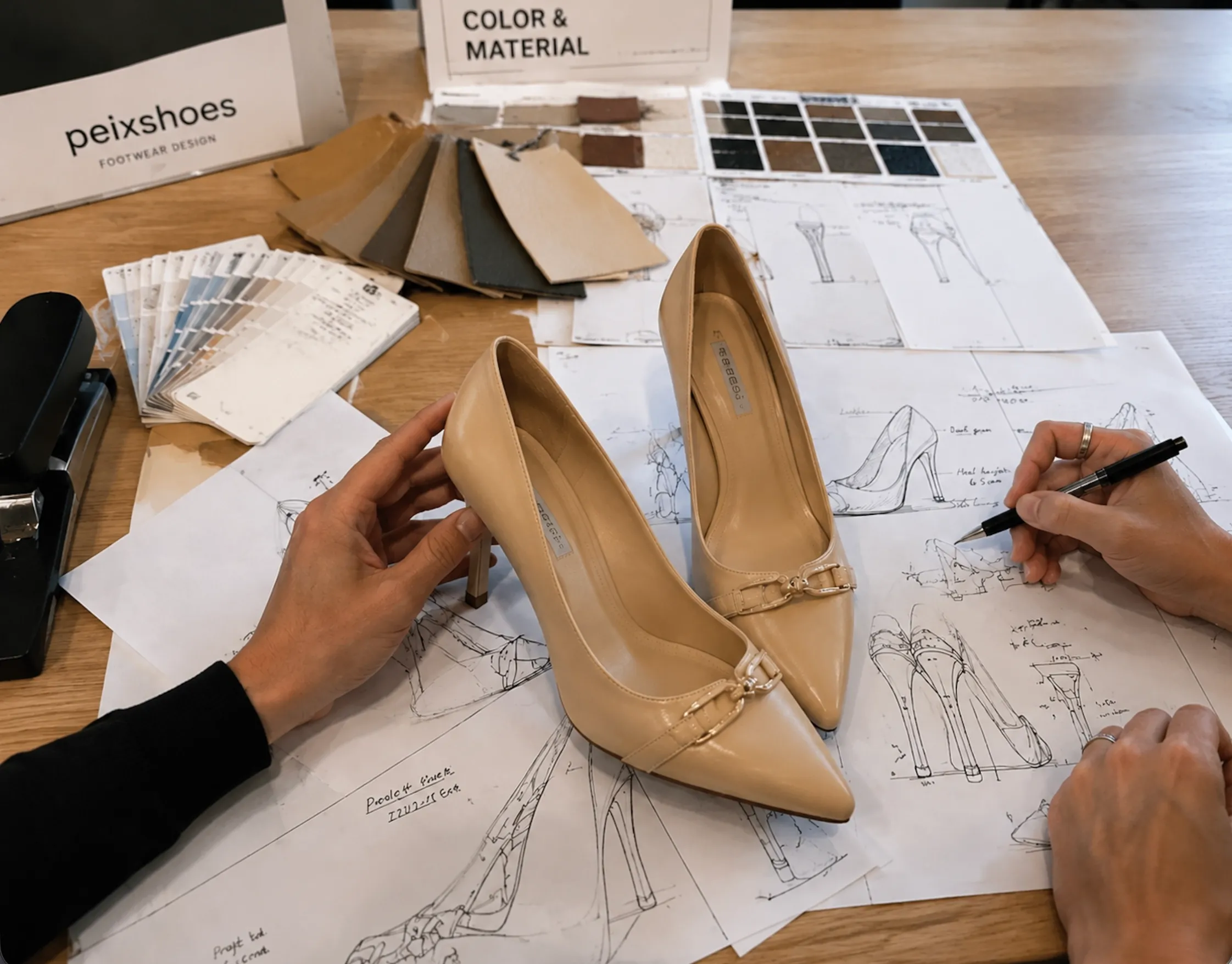
Each new colour multiplies size SKUs and can introduce separate material minimums. Use a small number of commercially distinct colours and share approved soles, heels or packaging where that does not weaken the design. Ask how MOQ applies per style, colour and component before finalising the range.
Plan size curves from evidence
Use historical sales, returns, retailer feedback and target-market data. A balanced total quantity can still produce dead stock when the size ratio is wrong. For a new market, use a controlled first order and keep a clear reorder plan. Browse Peix Shoes women's footwear to compare category roles, then use custom development to test the most important styles first.
Vera's practical judgment
I would remove a SKU when the team cannot explain which customer, occasion or price gap it serves. A smaller, better-defined collection gives buyers more room for correct sampling, fit review, photography and replenishment. Variety is useful only when the inventory logic is visible.
FAQ
How many styles should a first collection include?
There is no universal number. Start from budget, channel, MOQ and the number of styles the team can properly develop and sell.
Should every style have several colours?
No. Add a colour only when it serves a different demand or proven commercial need.
Can shared components reduce risk?
Yes, when the shared component is appropriate to each construction and the design still meets the product brief.
Next step
Send your proposed style, colour and quantity plan for an assortment and MOQ discussion.